Monday, March 30, 2015
It Follows
It Follows meets its college-age heroine floating in a swimming pool. An ant marches innocently along her arm. She drops her arm below the surface of the water. The ant is swallowed up by the liquid, its life gone in a flash.
On the surface, It Follows is representative of the current mumblegore movement inaugurated by young horror filmmakers like Ti West (House of the Devil), Jim Mickle (Stake Land) and Adam Wingard (The Guest). It is smart, naturalistic and shot on a shoestring budget. But on a deeper, more thematic level, It Follows exploits the conventions of the genre to inspect that tumultuous transitional period between youth and adulthood.
After sexing her boyfriend in the back of his cutlass, Jay Height finds she is the intended victim of an evil force. It can take the appearance of any person, is invisible to the rest of the world and if it catches her, will kill her. It’s like the stuff of elementary school sex-ed class, when that creepy gym teacher whose age was on the older side of completely indeterminate warned that sex would lead to disease and possibly death. There’s no little pill to save Jay from danger, no cream or ointment. Her disease will stay with her until she passes it on to a new sexual partner or it kills her.
There’s a commendable simplicity to director David Robert Mitchell’s story. His minimalist approach to violence is summed up in the opening sequence. An unknown girl flees her house and drives to the beach where she calls her father to apologize for the misdeeds she committed as a child. Something seems to watch her from a distance. Following an abrupt cut, the morning sun reveals the girl in a mutilated state, her leg bent back at the knee. Mitchell is not concerned with the murderous act. True horror lies in the stalk.
It Follows is infused with dread and executed with a boxer’s sense of timing. Every moment spent with Jay as she peers over her shoulder at mysterious interlopers that may or may not be the evil force heightens the delicious tension of the movie.
Its nostalgic design does little to detract from the creepiness of the piece. It emulates the films of horror’s golden years and apes the work of John Carpenter. Its opening sequence, captured in one shot, and a scene that sees Jay distracted at school by the presence of the evil force outside her window screams John Carpenter's Halloween. The ominous tracking shots, effective use of space and synth-driven soundtrack owe royalties to the master of fear.
But It Follows is more than mere homage. Mitchell mingles archetypical genre elements with his own mythic sensibilities to create a deliriously chilling metaphor for teen angst. Jay and her friends are becoming adults. The carefree days of their youth are slipping away as quickly as the life of the ant in the pool. Jays reflects on games she played as a kid to pass the time, other characters reminisce about first kisses. Those are memories that will last a lifetime. So too will those things that haunted them as children. The ridicule of classmates, the pressures of school - they will follow them forever.
Sunday, February 22, 2015
My Favorite Movies of 2014
10. JOE
Joe (Nicolas Cage), a hard-nosed ex-con trying to stay out of trouble, forms an unlikely bond with Gary (Tye Sheridan), a hard-working fifteen-year-old kid who's physically and mentally abused by his alcoholic father.
Nicolas Cage has been impersonated by more than one SNL cast member. He’s been in so many turds that he’s become a bit of a joke. But when he’s good, when his craziness is reigned in by a capable director, he can be terrific. Leaving Las Vegas, Bad Lieutenant, Raising Arizona: all enormously entertaining films illuminated by a terrific Cage performance. In Joe, he’s as good as he gets. His character is fragile and complicated, his matted beard, discolored tank-top and rough tattoos masking a warm interior. He lays with a hooker, carves a deer, gets shot in the chest and provides dry clothing to a boy he’s helped in from the rain, all in the same afternoon. He knows how precious life is and how quickly it can be misplaced.
Director David Gordon Green captures the bleak yet beautiful atmosphere of the backwoods Texas town. He litters the landscape with authentic feeling characters. You feel the strain of the people as they struggle to get by. (On a sad note, Gary Poulter, a homeless man cast by Green in the role of the alcoholic drifter, succumbed to alcoholism prior to the film’s release.)
Unfortunately, the film premiered early in the year and has been forgotten by short-sighted critics like myself whose top-ten lists consist mainly of movies released in the past few months.
9. THE GUEST
Remember being a kid and imagining yourself as a government soldier on a mission of vengeance? The Guest is the kind of story you would have thought up. In a year that saw a ton of great action flicks (John Wick, The Equalizer), The Guest was my favorite. Those other films took the cliche conventions of the genre and crystalized them. They were pure and I loved them for it. The Guest is not that. The Guest is something else. It’s a bit of a genre blender: a little bit action, a little bit drama, a little bit horror.
It toes the line between cool and corny. It took me a bit to decide if what director Adam Wingard had created was a cheesy send up or kick ass throwback. The scene that sealed the deal for me saw the film’s hero, David (Downton Abbey’s Dan Stevens), slinging a pair of kegs on his shoulder Magnus Ver Magnusson style.
Here’s the story: David shows up on the Peterson’s doorstep sporting fatigues and a KPG sweatshirt claiming to be a comrade of their son who died in action. Over the course of the next few days, anyone who has ever wronged the Pertersons starts showing up dead.
I was one of the few horror fans not enamored by Wingard’s previous effort, You’re Next. I argued that the film failed to escape the very cliches it professed to amend. The Guest, like its predecessor, takes notes from other pictures (Halloween, Death Dream, The Terminator), however, it refuses to yield to an established archetype. Just when you’re about to write off the plot as little more than a device to satisfy the film’s excesses, it surprises you and changes gears. Without giving away too much, I’ll just say that super-soldier David receives orders that come into collision with his prior programming. The result is a character unlike any we’ve seen before.
This, on top of its John Carpenter-inspired soundtrack, 1980s sentimentality and Halloween backdrop, results in the best action pic of the year.
8. INHERENT VICE
Paul Thomas Anderson’s groovy neo-noir about a private detective (Joaquin Phoenix) who’s hired by his ex-girlfriend (Katherine Waterston) to investigate a plot by the wife of her new billionaire boyfriend to have him institutionalized. Sound confusing? It is. But so is life. Our lives aren’t neatly arranged. There’s ritual within them sure: we eat, we go to work. But they’re episodic. None more than that of stoner dick, Doc Sportello.
Vice is his story, his vision of post-Manson Southern California. Massage parlors are fronts for prostitution, jazz musicians are communist supporters and police detectives are douchebags. Detective Christian “Bigfoot” Bjornsen (Josh Brolin) has “a twinkle in his eye that says civil-rights violation.”
Phoenix is irresistibly charismatic. He staggers from predicament to predicament promoting peace, love and happiness. Cinematographer Robert Elswit’s camera is sure to please. He captures Southern California in smokey blues and reds that carry an air of depravity.
Though it might prove too impenetrable for some audiences, it benefits from zany humor, masterful direction and sublime performances. A must see.
7. UNDER THE SKIN
Life lesson #34: When a dark-haired chick resembling Scarlett Johansson asks you to take a ride in her rape van, you say no. Wait, let me double check that. Yeah, I was right, you say no.
Scarlett plays a character, billed simply as The Female, who cruises around picking up random guys and luring them back to a seedy townhouse where they fall into an inter-dimensional void? An extraterrestrial portal? An intergalactic happy meal? I’m not quite sure. What I know is that something happens to these guys, something other-worldly and utterly awesome. When she picks up a man with a facial disfigurement, she seemingly has a change of heart. She lets him go and escapes herself into the Scottish Highlands where she hopes to assimilate into the human population. This pisses off her alien brethren who send a Martian fixer? An alien assassin? A live-in carpenter? Anyway, a guy on a motorcycle scoops up the man and sets out in pursuit of The Female.
Mica Levi’s beautiful and strange score turns on the emotions of the characters (anxious, sorrowful, frustrated), yet is so unique and infectious, it’s in regular rotation on my ipod playlist. It leads off with an ominous drone before giving way to a more avant-garde sound, the bizarre knocks and scratches somehow reflecting the emotional journey of the Johansson character.
Daniel Landin’s cinematography is on equal footing with the score. Hidden cameras were employed in early scenes to capture authentic reactions from the street walkers. The scenes of the poor guys following The Female into the townhouse and to their ultimate, icky demise are both poetic and creepy.
This is a polarizing movie. Some will love it, some will hate it, but all will agree it is unlike anything they’ve experienced before.
6. 20,000 DAYS ON EARTH
Long before Miley Cyrus floated in her swimming pool in Toluca Lake, goth rocker Nick Cave was enlightening audiences with his wildly original lyrics. He found love in a flower shop, pole danced in his birthday suit and took the Almighty to task, all in under 20,000 days.
Filmmakers Iain Forsyth and Jane Pollard concoct a mythological day in the life of the music icon in this subversive documentary. He waxes ecstatic with Ray Winstone, reminisces with Kylie Minogue and provides archivists materials for the national Nick Cave library. While the events of the day may be staged, the impassioned dialogue is very real. “The words I have written over the years are just a veneer. There are truths that lie beneath the surface of the words. Truths that rise up without warning like the humps of a sea monster and then disappear. What performance and song is to me, is finding a way to tempt the monster to the surface.” Much of the film is devoted to that very concept. We are provided a glimpse into Cave’s meditative process. Self reflection leads to discovery and ultimately disclosure via impassioned performance.
While the film may appeal most to fans of Cave’s work, it is a truly stirring piece that will inspire all those interested in the creative process. “To act on a bad idea is better than to not act at all, because the worth of the idea never becomes apparent until you do it.”
5. BOYHOOD
Throughout his career, Richard Linklater has successfully passed back and forth from art house cinema (Slacker, Before Sunrise) to mainstream fare (School of Rock). Like a number of his artsier pictures, Boyhood is loose on narrative. Its simple tale of a young boy growing up in Texas is actually quite ambitious. Shot intermittently over the course of 12 years, the film sees Mason (Ellar Coltrane) and his family aging literally right before our eyes. It is like nothing you have seen or will likely ever see again.
Ethan Hawke is particularly good in the role of Mason’s distant father. A sequence that sees him attempting to reconnect with his kids through bowling is especially emotional. There is sincerity in his eyes when he expresses a desire to spend more time with them. The glow on their faces is genuine. We’re moments into the film and already we’ve forgotten we’re watching a movie. When their mother argues with Mason Sr. about his newfound desire to be a father, we observe helplessly through an upstairs window along side Mason and his sister.
Hawkes plays the most dynamic character in the picture, his growth best exemplified through his choice in vehicles: muscle car as a young man, minivan as adult. Coltrane is a bit too hip as a teen and Marco Perella a bit over the top as Mason’s step-father, but the collective power of the cast is undeniable.
4. COLD IN JULY
In Mickle’s hard-edged pulp thriller, an ordinary husband and father becomes a local hero after gunning down a small-time crook who breaks into his home at night. The dead man’s father, Ben Russell (Sam Shepard), comes looking for payback, though not before Richard climbs back under the covers, still trying to pretend life is normal. Before long, Richard and Ben find themselves reluctantly aligned, joining forces to take out a far more dangerous man.
3. WHIPLASH
For those that don’t know, I teach film at a local high school. At a professional development meeting earlier this year, an expert lectured to us on the topic of feedback as a part of formative assessment. He suggested that constructive feedback on work leads to students performing better on future tasks, while both the absence of comments and even positive feedback result in no change in performance. Terence Fletcher (J.K. Simmons), the celebrated jazz instructor in Damien Chazelle’s Whiplash, would subscribe whole-heartedly to this theory. “There are no two words in the English language more harmful than good job.” He berates and belittles his students in an effort to help them become the best they can be. “You are a worthless, friendless, faggot-lipped little piece of shit whose mommy left daddy when she figured out he wasn't Eugene O'Neill and who's now weeping and slobbering all over my drum set like a fucking nine-year-old girl."
J.K. Simmons is a revelation. You can feel each of his tongue-lashings, every one of his blistering gibes through and through. There was no character worth hating more in 2014 than Terence Fletcher.
The film takes the mentor-pupil genre and tears away all the cheese, resulting in an intense, inspiring experience. The emotional power of the final scene is undeniable.
2. NIGHTCRAWLER
Nightcrawler offers a haunting and visceral examination of psychosis and obsession. Set in LA at night, it stars Jake Gyllenhaal as Lou Bloom, an ambitions young man who trades in his career as a thief for one in the field of crime journalism. Aided by a local TV news producer (Rene Russo) Lou quickly blooms into the best nightcrawler in the business.
Dan Gilroy’s gritty aesthetic owes a lot to Scorsese and the hard-hitting movies of the post-classical period. There’s a chilliness to the neon and smoke infused streets and the ease with which Lou openly operates. The picture is driven by Gyllenhaal’s haunting performance as a man who follows through on every opportunity, even if it means breaking the law. I’d be lying if I said I didn’t identify with the character on a primal level. I rooted for him the way I did other charismatic sociopaths in pop culture: Patrick Bateman, Walter White. That’s part of the point of the movie. We eat this stuff up. No one knows that better than the news media. There’s a great scene that sees Lou commenting on the fakeness of the background skyline in the news studio. This scene says so much about the news industry, the formally dressed anchors that deliver the news and Lou himself.
Avant-garde director Jim Jarmusch does brooding vampires who pass the time listening to rockabilly music and playing chess. And it’s awesome. In a year filled with cool movies, Only Lovers Left Alive is by far the coolest.
Indie rocker Adam (Tom Hiddleston) and his hipster wife Eve (Tilda Swinton) have been in love for years, through wars and despite the deteriorating condition of humankind. But can their romance survive the arrival of Eve’s promiscuous younger sister (Mia Wasikowska) and the schmaltzy state of rock and roll?
Set against the handsomely bleak backdrop of Detroit and Tangier, Jim Jarmusch’s lyrical vampire movie paints an extraordinary picture of romance, its reanimated characters asking viewers to consider what it means to be alive. It restores a sense of nobility to a genre that in recent years has been reduced to sissified musings for WB enthusiasts. Jarmusch’s script adds depth to the vampire archetype, focusing on the banality of the syndrome: getting older while people get stupid and trends grow lame. Only Lovers Left Alive is everything we’ve come to expect from a Jarmusch film: it is quirky and cool, humorous and somber and at all times, gorgeous to look at.
OTHER FILMS I LIKED:
Blue Ruin, Enemy, The Equalizer, Fury, Honeymoon, Interstellar, John Wick, Locke, A Most Violent Year, Night Moves, The Rover, We Are the Best
Thursday, February 19, 2015
We Are the Best
Klara (Mira Grosin) and Bobo (Mira Barkhammar), two thirteen-year-old rebels who wear more hair gel than Pauly D, form an all-girl punk band despite having no instruments and no discernible talent.
Watching We Are the Best was one of the most fun experiences I had at the movies all year. It’s a sweet little tale of young women experiencing the growing pains of life set to a cool punk soundtrack. Anchored by impressive performances by Grosin and Barkhammar, We Are the Best is a delightfully natural vision of youth. It’s the kind of movie that has you questioning whether the producers cast actors to play their heroines or simply aimed their cameras at real-life girls acting out. A scene that sees the girls shouting, “Crush capitalism” while refusing to climb out of a cardboard box that’s blocking patrons from reaching the counter at a fast food restaurant is a prime example.
Thursday, February 5, 2015
THE BABADOOK
When he discovers a pop-up book about a monstrous creature that stalks children in their homes on the shelf in his room, Samuel’s behavior worsens. He convinces himself that the creature, called The Babadook, is out to kill him. Amelia wants nothing more than to curl up in a ball and wait for help. But when a darkened figure floats through her room, it dawns on her that Samuel may not be so crazy after all.
I had the opportunity a few years back to have dinner with George A. Romero. There was a point when someone at the table asked about the social undertones in his films. I don’t recall his exact response, but I remember him becoming slightly enraged by that word...undertones. That the in-your-face attacks on racism, consumerism and traditional notions of masculinity running through his films could be construed as background noise was appalling to him. I imagine Romero would be a big fan of The Babadook. A film that wears its allegory on its sleeve, and its collar, and its pant leg and everywhere else, it builds horror via Amelia’s inability to connect with her son. She wants so desperately to love him, but her face, twisted with tension, belies her apprehension. I don’t recall any closeups of her hands, but if we saw them, I imagine the nails would be chewed down to the quick. The dread of dealing with him each day, once an invisible demon buried deep inside her, has outwardly manifested itself in the form of an inky-black monster.
Davis gives a masterful performance as Amelia . Her bone-white skin and pallid eyes the portrait of a woman on the verge of a breakdown. I loved watching her hair change as she spiraled into the trap of her own mind, warm and coiffured at the start, an unruly nest of tangles by film’s end. Wiseman matches her intensity at every turn. It’s considered taboo in movies to hurt a child. In The Babadook, Wiseman creates a kid you want to punch in the face.
The Babadook is a new horror flick, but it has its roots in the supernatural pictures of yesteryear. In an era dominated by torture porn, it succeeds in building suspense the old-fashioned way. It effectively rejects the showy, gore-slicked inclinations of modern horror movies in lieu of a tense, psychological approach. It is tight, don’t get me wrong. It develops at a rapid rate. I was reminded of the films of Edgar Wright: all the excess fat has been trimmed from the edges. In fact, that’s my one knock against the film. Scenes build torturously only to terminate as the horror hits its peak. The audience is not provided time to ruminate on what they just witnessed. Characters are introduced only to disappear a moment later, leaving the audience a bit puzzled. But this is a minor argument against a film that otherwise approaches perfection.
The movie threatens to regress into familiar territory in its third act, however, hits you with a twist in its final moments that is not only gutsy, but completely without warning. Some demons you just can’t shake, they haunt you for life. You have to learn to deal with them.
Thursday, January 29, 2015
INHERENT VICE
2014 saw a slew of paint-by-number character dramas. You toss the standard axioms into a hat - poignancy, romance, overcoming extreme adversity - shake and dump. The result: The Theory of Everything, Selma, The Imitation Game.
Paul Thomas Anderson’s trippy and curious Inherent Vice is a mysterious neo-noir that breaks from conventional structure at every turn. Private Dick Doc Sportello (Joaquin Phoenix) is seduced by his ex-girlfriend, Shasta (Katherine Waterston), into investigating an evil plot hatched by the wife of her new billionaire boyfriend, which leads him to discover a group of drug smugglers known as the Golden Fang and an FBI hitman called Prussia. At least I think that’s what happens.
Many viewers will be put off by the film’s lack of complete coherence, but the details of the narrative aren’t overly important. It doesn’t matter if you’re left scratching your head at the end. What matters is the journey. Its subversive style, batty characters and stoner humor combine to create a dizzying experience - not unlike the feeling of being high. BTW, the film is thankfully void of one of those overly-stylized drug-induced fantasy sequences. The characters in the film are every bit as lost as the audience. Doc utilizes a notebook when questioning someone, but his notes are limited to one or two nonsensical words. Shasta is asked at one point what inherent vice means. She responds that she has no idea.
Phoenix is amazing. He's on another level. He bears the facial expression of a man out of place in the world, his mutton chops and paisley patters as out of style as his pre-Charles Manson ideals. Anderson shoots him in long takes, requiring his character to run the gamut of human emotionality in short stretches of time. His co-stars nearly match him stride for stride.
Robert Elswit’s camera casts a spell over the audience, its moody blue and red hues suggesting something otherworldly lurking behind the foggy streets of Southern California. His compositions take the viewer away to another time when hardboiled movie detectives spoke to a cynical public.
All seven of Anderson’s features toy with film grammar in one way or another, but none of them compare to the craziness of Inherent Vice. It is, perhaps, his masterstroke.
Monday, March 3, 2014
Pompeii
I wanted so much for Pompeii to be good. I had a great response prepared. Go ahead, ask me what I thought of Pompeii. "It was a blast." What, too corny? Too cheesy? So is Paul W.S. Anderson’s tawdry historical epic about a gladiator who falls for the object of an evil Roman’s infatuation. Consider a scene that sees Jack and Rose arguing over who will take a spot on the raft before succumbing to hypothermia. Wrong movie? I meant a scene that sees our gladiator squabbling with his love over who will take the horse while a river of molten lava bears down on them. The movie wasn’t as awful as most are claiming. It was watchable in the way those sci-fi channel retreads of superior genre flicks are watchable. If it was an SAT question, it would read like one of those annoying analogies: Marshmallow Mateys is to Lucky Charms as Pompeii is to Gladiator. I expected so much more Jon Snow.
Sunday, March 2, 2014
My Favorite Films of 2013
Director
Derek Cianfrance’s 2010 examination of a failed marriage (Blue Valentine) was
received with enthusiastic approval. His second effort is even stronger. An
ambitious epic about the lengths to which fathers will go to protect their sons
and the emotional impressions that are produced via the decisions they make, The
Place Beyond the Pines is a cinematic feat of form and beauty. Eschewing
narrative convention, the story is presented like a triptych painting, with each
panel being a bit more gloomy than the last. It’s melancholy tone is aided by
Mike Patton’s somber score and Sean Bobbit’s gorgeous photography. Cianfrance
tells a humorous story about his decision to not use Valentine cinematographer
Andrij Parekh on the film’s blu ray commentary track. The choice was a good one.
Bobbit’s muted colors and naturalistic views allow for a picture that is both
roughly beautiful and emotionally honest. Ryan Gosling gives a hypnotic
performance. He and Cianfrance make a good team. Another story on the commentary
track comes during a scene that sees the Gosling character witnessing the
christening of his son. Another man takes part in the ceremony. Gosling strays
from the script. His decision is not only more in tune with the character, it
also allows for a more impressing experience for the audience.
A
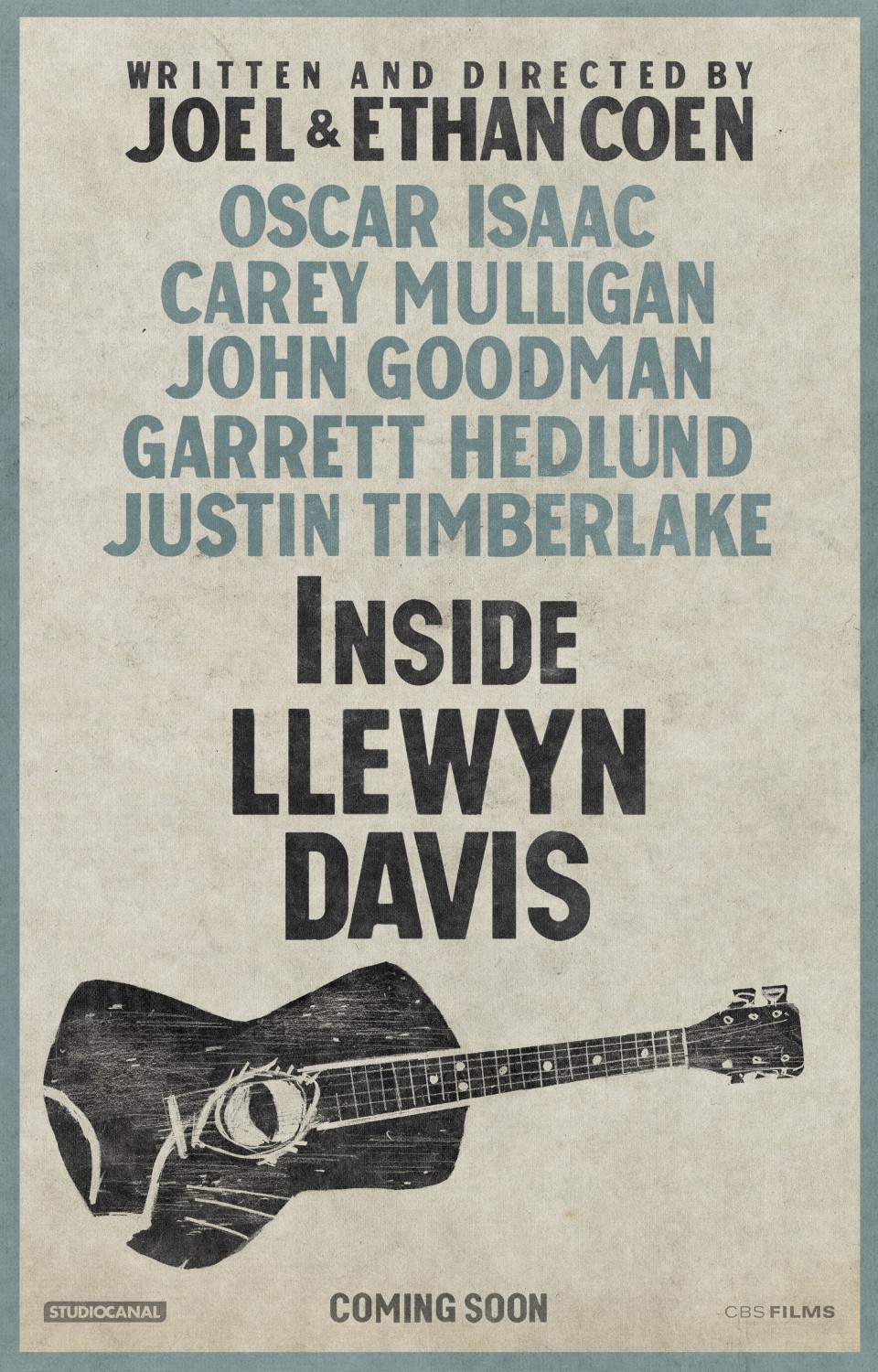
fictionalized look at the 1960s folk scene through the eyes of a struggling
musician, Inside Llewyn Davis is the Coen brother’s most thoughtful picture
since Fargo. The Coens are completely uncompromising. There is nothing cliche in
their writing. Traditional film grammar and decorum take a back seat to
audacious style and daring technique. It is somewhat ironic that the inability
to admit to compromise is often what hinders the progress of Llewyn in this
film. One memorable moment in the picture sees a rock manager asking Llewyn if
he can sing backup. Llewyn responds, "No. Well, yes, but no." Another witnesses
him making the long trek back home to NY after a failed audition in Chicago. His
journey is interrupted by a wounded cat that stumbles across the road and into
the woods. The symbolism is abounding. Mirroring a traditional folk song in
composition, the film is darkly comic, contains terrific performances and a
great soundtrack.
Matthew
McConaughey appears in three films on this list. Here he plays Ron Woodroof, a
swindler living in Dallas in the mid 80s. He’s diagnosed with AIDS and given
less than a month to live. He employs his unscrupulous manner to work the system
and obtain medication that allows him to extend his life seven years.
McConaughey delivered a convoluted mess of an acceptance speech at the SAG
awards after winning a trophy for best actor. There was a truth at its center,
that actors hope to get that one career-defining role that transcends all their
previous work and catapults them to preeminent status. This is his. The movie
rests squarely on his shoulders and he delivers. Nearly as impressive is Jared
Leto as Rayon, a trans-gender AIDS patient and unlikely ally who joins Woodroof
in his quest.
Mud
solidifies Jeff Nichols (Shotgun Stories, Take Shelter) position as one of the
best filmmakers working today. Drawing inspiration from Stand By Me and Huck
Finn, Mud offers a poignant coming-of-age tale about those hard-to-capture
feelings of love and trust. Resembling a fairy tale in makeup, its unhurried
pace and arresting visual style render the unremarkable extraordinary. Marking
another achievement in the career turn-around of Matthew McConaughey, the
picture presents an affecting portrait of regional lifestyles and peoples that
are called things like Neckbone and Mud.
Is
it an indictment of today’s narcissistic youth or a celebration of their
nihilistic views? Is it a feminist statement about the individuality of women or
does it objectify is sexualized young cast? Perhaps the debate among viewers
correlates to what’s truly at the film’s core: the barrage of conflicting
messages that assail today’s youth on a daily basis. Consider that Beyonce, the
epitome of woman power, performed at the Grammys in her underwear while Jay Z
sang, "Your breasteses is my breakfestes." One thing is certain, Spring Breakers
projects a frank and compellingly raw view of today’s teenagers. It’s enigmatic
filmmaking from a bold talent. Its neon-infused color scheme and overly
saturated imagery serve to both examine and speak to a generation raised on Mtv
and the internet. It is a kaleidoscopic attack on the senses, a whirlwind of sex
and booze set to the electronic stylings of Skrillex. And James Franco has
cornrows and a grill.
The
Wolf of Wall Street is hilarious. I didn’t laugh out loud the way I did during
this irreverent look at corrupt New York stockbroker Jordan Belfort more all
year. The movie makes no excuses. The character is no different in the
179th minute than he was in the
first. Yet there is something irresistible about it. Maybe it’s Leonardo
Dicaprio’s energetic performance; or Martin Scorsese’s furious pace. His
long-time editor, Thelma Schoonmaker, deserves an award every time out. A scene
that sees Belfort and his accommodating sidekick Donnie (played by comedic crazy
person Jonah Hill) high on quaaludes is an instant classic. I still smile every
time I picture Belfort, provided new vigor by a shot of coke, barreling through
his wife to get to his dying friend. "Step aside."
Bruce
Dern plays a stubborn old man intent on hiking to Nebraska to collect a $1
million sweepstakes prize. It doesn’t seem built for mass consumption, yet its
austere visuals and mordant humor are resonating with viewers. Shot in stark
black a white, a compliment to the sparse expanse of the American Midwest, the
film features a career-defining role for Dern. He wears all the weariness of a
broken-down old man unsatisfied with the legacy he will leave behind. When asked
what he would do with the money, he responds, he’d get a truck, an air
compressor and most importantly, leave something to his children. There’s a
moment when he discovers he’s achieved the latter wish and it’s truly
satisfying. Alexander Payne is a simplistic flimmaker. All the award nominations
are a bit baffling. But he creates a refreshingly funny, touching and
unfalteringly entertaining movie with Nebraska.
I
am typically not a fan of pictures that interweave the stories of several
characters. I found Disconnect's cautionary tale, however, to be both powerful
and irresistible. A story involving two teen boys using a false female facebook
account to contact a reserved classmate is especially timely. Honestly, the
film does not contribute much to the discussion of social networking. It's a
dangerous world that seems somehow separated from our own and has ensnared each
of us at some point. But to see its pitfalls played out on screen is truely
harrowing. The film is wonderfully acted and competently directed. Henry Alex
Rubin moves seamlessly between the tales in route to an exciting finish.
Unfortunately, poor marketing resulted Disconnect going unnoticed by filmgoers
and removed from award discussion. Seek it out on DVD.
The
Secret Life of Walter Mitty was a welcome surprise, way more engaging than its
ads and PG rating let on, smarter than what we’ve come to expect from
director/star Ben Stiller. A lot of people are trashing the film for abandoning
the sardonic tone of the Thurber story it’s based on. I know nothing about that,
I have not read the story. What I do know is that Stiller’s version of a
day-dreaming negative assets manager (look it up) who goes on a real life
adventure more remarkable than anything he could have imagined to save his job
is a testament to the magic of movies and their ability to inspire. And that’s
what good movies do; affect us, take us to places we’ve never been. Mitty does
that perhaps better than any other picture this year.
Werner
Herzog and Errol Morris have become synonymous with documentary filmmaking. They
are both attached to The Act of Killing. Indonesia, 1965. Local gangsters Anwar
Congo and Adi Zulkadry go from scalping movie tickets to scalping alleged
communists. All said, they helped the Indonesian military kill more than a
million people in a year. The Act of Killing seeks to examine the impact the
killings had on the perpetrators by having them reenact the terror. This is a
tough watch and not one I will be revisiting any time soon. But it’s a tribute
to the power of documentary filmmaking and its ability to galvanize viewers.
Many horror films employ faceless, emotionless killers to create terror. They
are devoid of personality, there is no justification to their actions. We
imprint them with our own fears. The Act of Killing puts a face on murder. We
are forced to sit with these monsters as they boast about the terrible things
they have done.
Films I was most disappointed in:
American Hustle, Blue is the Warmest Color, Fruitvale Station, Gravity, To The Wonder
10 more films I liked:
12 Years a Slave, Afternoon Delight, All is Lost, Blue Jasmine, The Counselor, The Hobbit, Only God Forgives, Pacific Rim, Short Term 12, Stories We Tell
Films I was most disappointed in:
American Hustle, Blue is the Warmest Color, Fruitvale Station, Gravity, To The Wonder
Subscribe to:
Posts (Atom)